This is a purely for-fun project that I had started a month ago, when the country was in a higher-than average season of elections. Basically, I wanted to figure out a few things - 1. Has voter turnout ever been this low? 2. How many times have our two main parties (Conservative and Liberal) been in power in this country? 3. How have results differed between provinces, and between provincial and federal levels? This write-up answers these questions and more.







Data Collection & Methodology
To start, I created a spreadsheet which tracked every political party in power by province since Confederation. The spreadsheet (at bottom of article) has all provincial and federal election data, sorted by colour (darker colours meaning majority governments, and lighter colours are minority governments), with voter turnout percentages where available. This information was mostly derived from provincial election sites - some information was easier to find than others.
Note that this information is 100% human input and COULD have mistakes in either voter turnout or years.
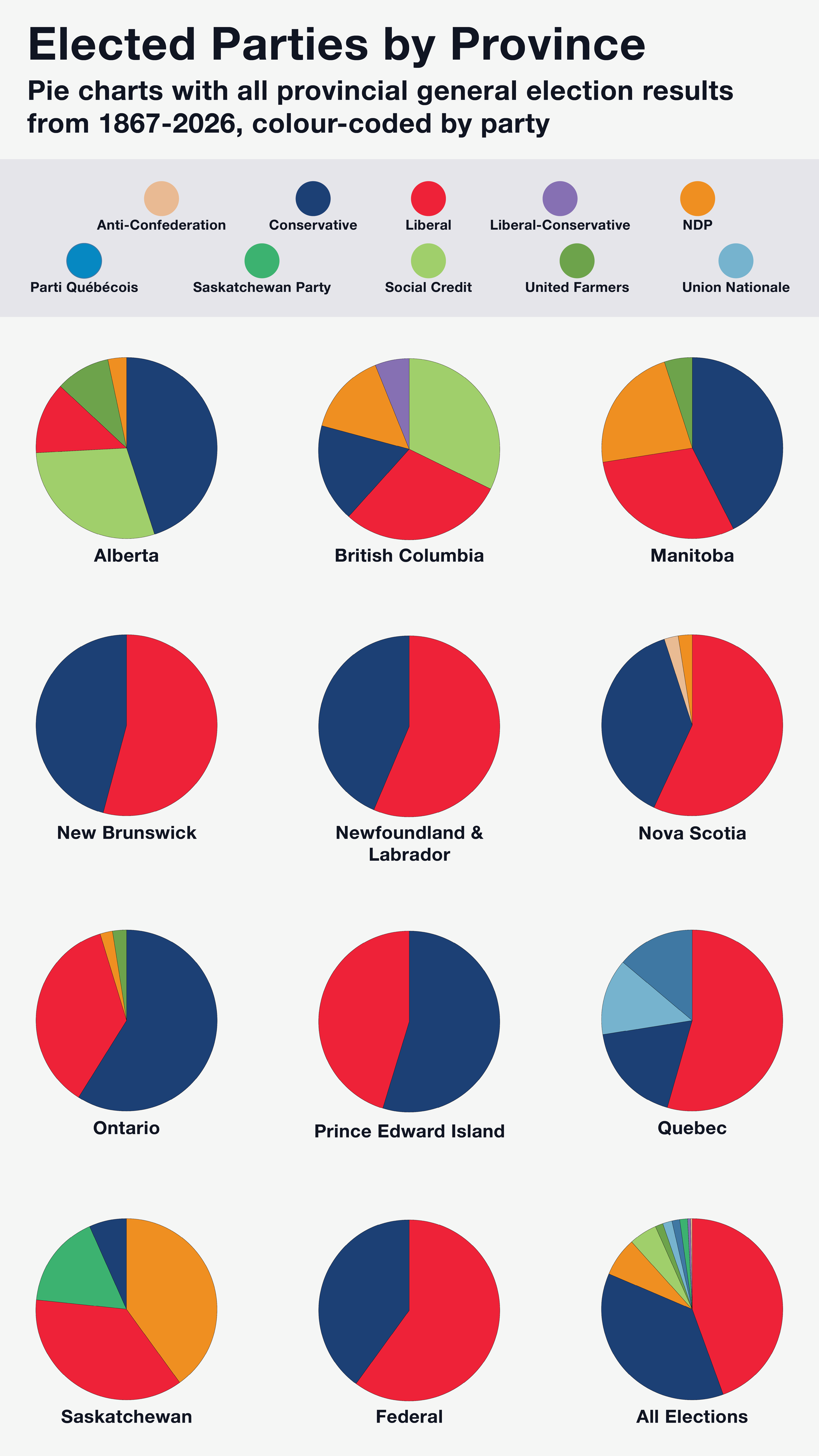
Elected Parties by Province, 1867-2026
Which party has held power for the longest consecutive time in a province, and when?
The Conservative party in Ontario won 12 consecutive elections from 1943-1987 - spending 43 years in power.
Next up would be the Social Credit party in Alberta, that won nine consecutive elections and held power for 36 years from 1935-1971.
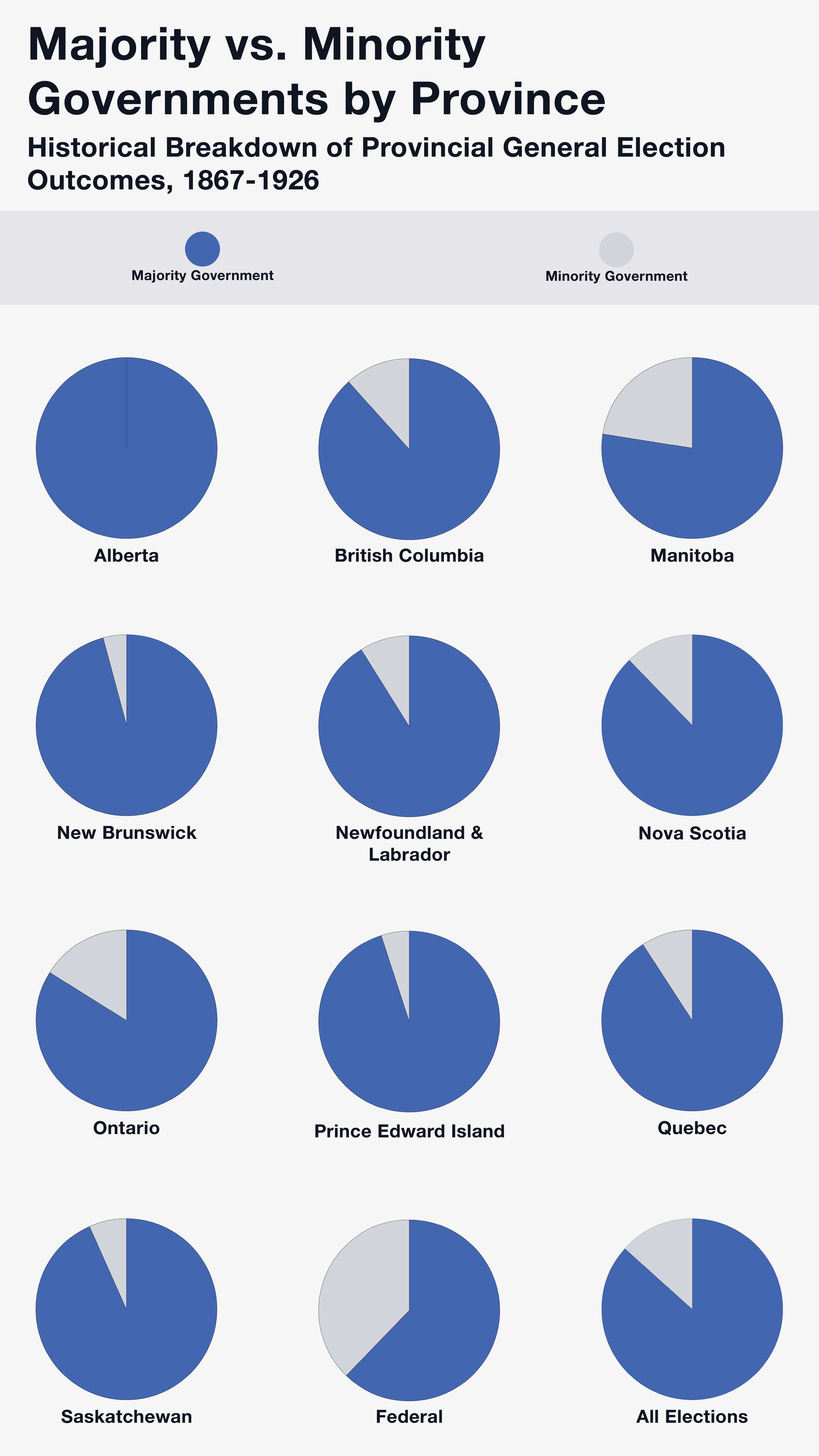
Majority Governments vs. Minority Governments by Province, 1867-2026
Which province has had the most minority governments?
Manitoba has voted in 9 minority governments since they started holding elections. Like Ontario, their first-ever election resulted in a minority Conservative government.
Which province has had the least minority governments?
Alberta has ONLY elected majority governments - they have never elected a minority.
We Canadians tend to elect federal minorities the most - we have had 17 minority governments elected and 28 majority in our history. Note, that I went by results of general election - so this doesn’t account for governments that have lost or gained a majority due to byelections and/or floor crossings in office.
Which party has been in power the most times?
The Liberals have been elected 177 times in Canadian history. Conservatives have been elected 147 times. Third is the NDP (grouped with its predecessor CCF) with 28 elections, and fourth is the now-defunct Social Credit Party with 20 elections secured.
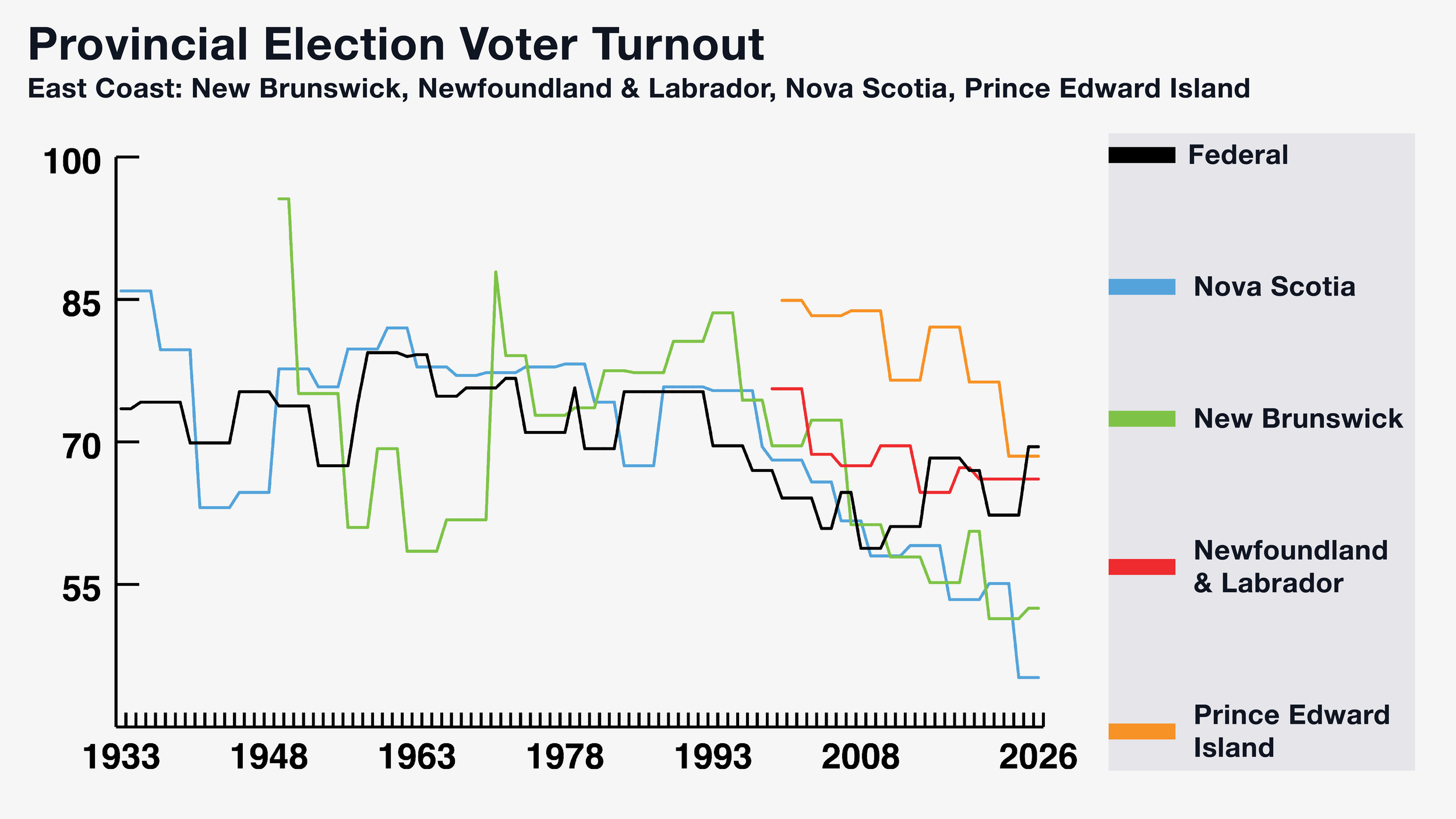
Provincial Election Voter Turnout, East Coast
Which provincial election had the highest voter turnout and when?
Newfoundland (not yet called Newfoundland & Labrador) holds the record for highest voter turnout - with 95.6% of voters showing up at the polls in their first-ever provincial election after joining Canada in 1949.
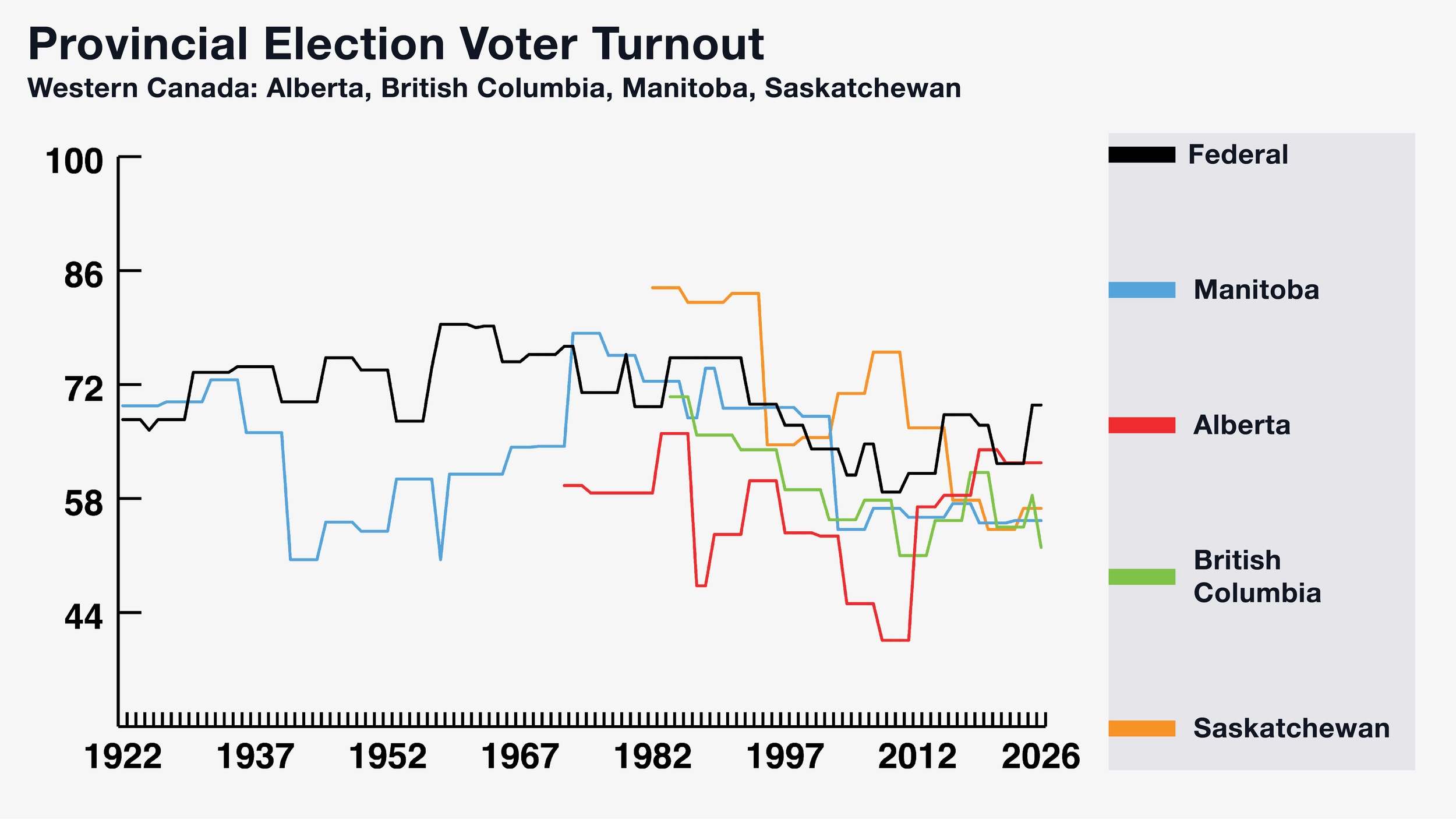
Provincial Election Voter Turnout, Western Canada
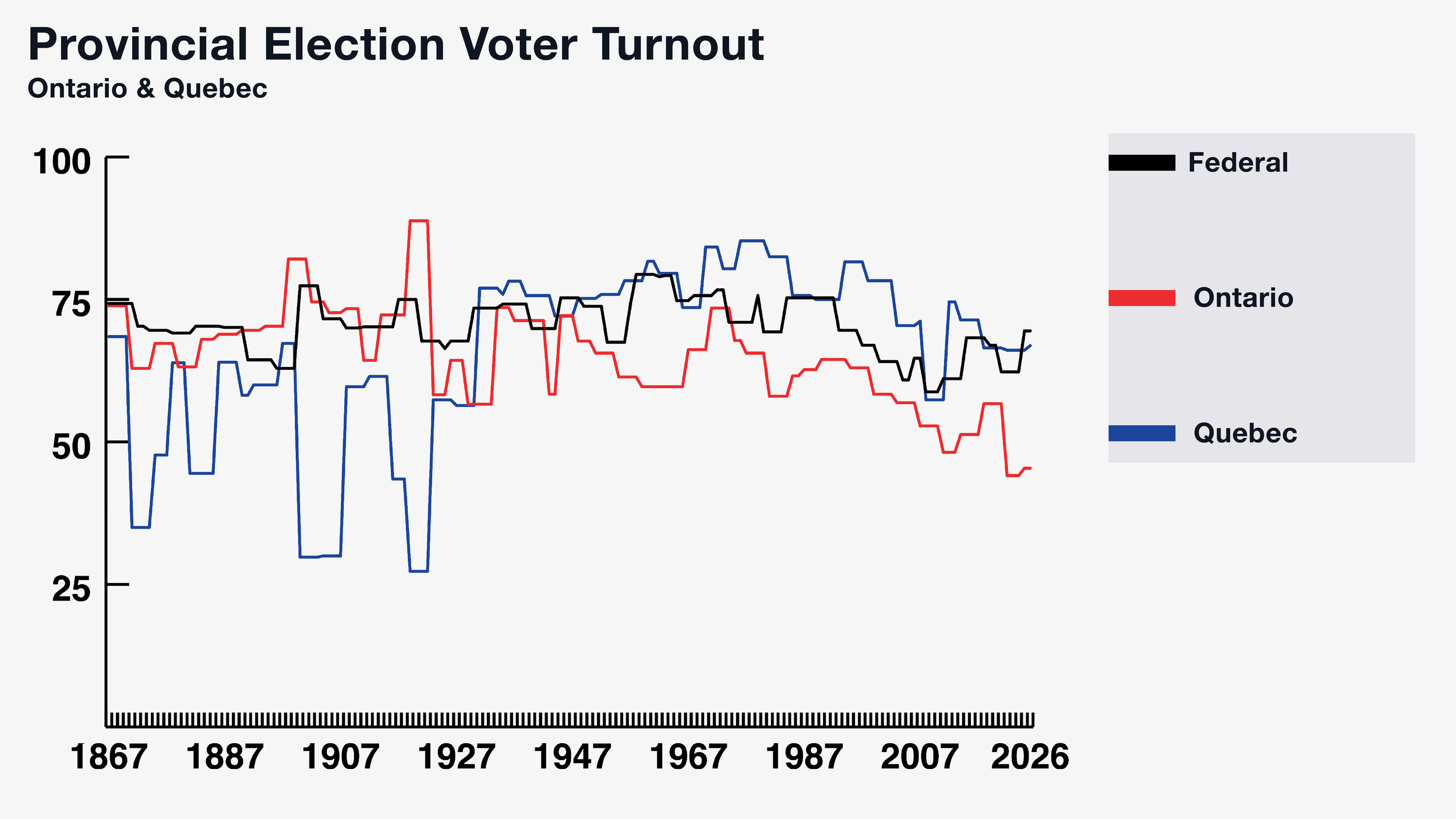
Provincial Election Voter Turnout, Ontario & Quebec
Which provincial election had the lowest voter turnout and when?
Voter turnout in the 1919 Quebec election had the lowest voter turnout in all of Canada in any provincial election at 27.3%. According to Elections Quebec, this is because many candidates ran unopposed - 43/81 ridings had unopposed candidates in them. Interestingly enough, this election was the year that Ontario had its highest voter turnout at 88%.
Has there ever been a time when Canada largely elected the same party across provinces and federally?
There was one period of a couple years when the provinces and the federal government had elected the same colour: the years 1897-1899.
This is the only time in Canadian history that the federal government and provincial governments voted in the same party - all electing a Liberal majority. However, data does not include British Columbia and New Brunswick - at the time, they did not hold elections by party. So that only accounted for five provinces at the time - Manitoba, Nova Scotia, Ontario, Prince Edward Island and Quebec. In 1897, Wilfred Laurier was Prime Minister, the gold rush was just beginning, and Canadian rail lines were booming.
Honourable Mentions:
1940-1942: During a W.L. Mackenzie King majority at the federal level, and in the middle of WW2, 8/9 provinces also had Liberal governments. The only outlier was Alberta, where the Social Credit party was well into its long-standing tenure in power. This was a few years before Newfoundland joined Confederation.
1985: A Conservative federal government also came at a time when 7/10 Canadian provinces had Conservative governments in power. The outliers at this time were British Columbia, whose Social Credit party held power, Manitoba, who had a minority NDP government, and Quebec, that had elected a Liberal majority.
Has there ever been a time when Canada had a diverse group of parties in power between the provincial and federal governments?
Yes, this is a more common trend than the previous point. Here’s a timeline of political “diversity” between provincial and federal governments:
1952: In the post-war era, this year had six distinct parties in power - five Liberal governments (one federally, with Manitoba, Newfoundland, Nova Scotia and Prince Edward Island) and two Conservative governments in New Brunswick and Ontario. Alberta had the Social Credit party in its fourth consecutive term. In British Columbia, there was a Liberal-Conservative coalition just ending its second term in power. Quebec’s Union Nationale party was the dominant Conservative party at the time and re-elected this year for a third term, but was formed out of a coalition with dissident Liberals. Lastly, Saskatchewan’s Cooperative Commonwealth Federation (CCF) was in their eighth year of power. A decade later, the CCF would evolve into the New Democratic Party.
1976-1978: Five political parties were in power federally and provincially. Federally the Liberals were in power, and held power in Nova Scotia and Prince Edward Island (a power which flipped to Conservative in both provinces in the next two years after). The NDP held power in Manitoba and Saskatchewan, the Social Credit party was back in power after a brief tenure by the NDP in British Columbia, and the newly-formed Parti Quebecois were first elected in Quebec in 1976.
After this period in which an election happened at least once in every province and federally, it was the first time since Confederation that a Liberal party did not hold power in any province or federally. It was short-lived, however, as the Trudeau Liberals regained a slim majority once again in the 1980 election.
2012-2013: Another period where five political parties were in power in Canada: Conservatives, Liberals, NDP, Parti Quebecois and the Saskatchewan Party.
2026: Currently, five political parties are in power in Canada - Liberals, Conservatives, NDP, Parti Quebecois and the Saskatchewan Party.
Honourable Mentions:
1994-1995: Four political parties dominated the Canadian landscape (Liberal, Conservative, NDP and Parti Quebecois).
2014-2019: Four political parties, again, have been in power in Canada (Liberal, Conservative, NDP and the Saskatchewan Party).
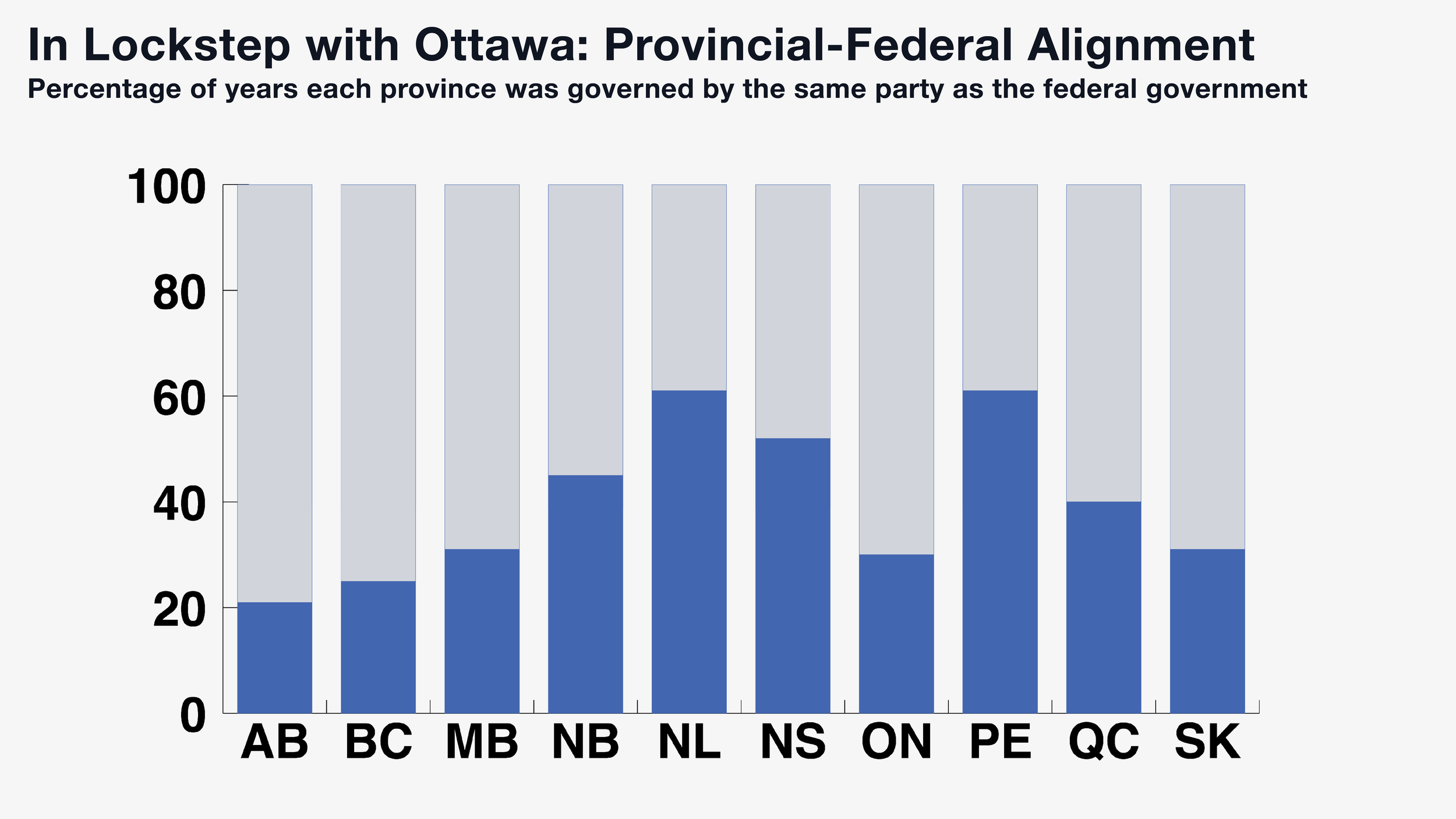
Provincial-Federal Party Alignment, 1867-2026
Are there any instances of a province historically aligning itself with the party in power?
Yes, each province has elected the same colour provincially as in power federally at some point in their history. The least amount of harmony is from Alberta and British Columbia, that have had the same political party in power 21 and 25% respectively, as who is serving federally, and Ontario with 30%. The most amount of political harmony is on the east coast - Newfoundland and PEI have both had 61% of years where the party in power provincially is the same federally, and next is Nova Scotia with 52%.
What can we learn from the past to bring into the future?
2026 is a transformative time for Canadian politics - we have a majority Liberal government, and five parties are in power provincially. If you look at 2016 versus 2026, provincial parties have changed from mostly Liberal (7/10 provinces in 2015) to mostly Conservative (6/10 in 2026). Voter turnout is mainly below average amongst provinces - excepting Ontario and Nova Scotia, whose most recent provincial elections saw the lowest voter turn outs of all time.
In the data, you tend to see shifts in colour blocks gradually before a clear political party wave begins. And during times of global conflict that Canada is a part of, you don’t see much change in party power.
Three provincial elections are set to happen in 2027: Alberta, Manitoba and Prince Edward Island. Alberta and PEI currently have Conservative majorities while Manitoba has an NDP majority. Historically, Alberta and Manitoba have not quite aligned themselves to the party in power as much as PEI has.
The current premiers of Alberta (Danielle Smith) and Manitoba (Wab Kinew) have grabbed more national (and international) attention than the premier of PEI (Rob Lantz), so one thing is for certain: these elections will see more media coverage than PEI’s.
Will we see PEI vote in another Liberal government? Their last election had their lowest recorded voter turnout, though sits on the higher end of turnout compared to other provincial elections. Will Manitoba, the province with the most minority governments elected, add another one to make it an even 10? Will Alberta see a leadership change? Not sure. What I do think though is that it will be another interesting, and worth watching closely, year of elections.
More “Fun” Facts & Trends
Party Sweeps: Two times in Canadian provincial election history, the political party in power won every single seat in the legislature. Prince Edward Island’s Liberal party in the 1935 election and New Brunswick’s Liberal party in the 1987 election.
One trend I noticed is how different the eastern and western areas of Canada elects provincial parties. The east coast tends to be similar in that they mainly elect Conservative or Liberal governments (the only exception is Nova Scotia, that had an Anti-Confederation party in their first-ever election, and one NDP majority elected in 2009) - and they tend to be more politically aligned with the party in power federally. In the western provinces, you see more independent political parties elected provincially, and less alignment with the federal party in power.
Additional Notes
In the early history of some provinces, like British Columbia and New Brunswick, political parties did not exist in provincial politics, which is why in my spreadsheet file these are greyed out.
I did not include territories (Yukon, Northwest Territories, Nunavut) - Northwest Territories and Nunavut do not elect parties, and Yukon has only done so for a relatively short duration. Initially I tried including YT in this analysis but it skewed data.
Available election information varies greatly by province. In my opinion, the best province for provincial election results is Quebec - the worst is Prince Edward Island. Quebec is the best because they have easily accessible tables and detailed writeups on election history. PEI is the worst - I can only find voter turnout data starting in 2000.
I counted majority/minority seats at election time, so in the case of federal elections, we do not count byelections or floor crossers, which skews the data for the most recent federal election (elected minority while they now have a majority).
Sources
https://electionsmanitoba.ca/en
https://www.electionsnb.ca/content/enb/en.html
https://www.elections.gov.nl.ca/
https://electionsnovascotia.ca/
https://www.elections.on.ca/home
https://www.electionsquebec.qc.ca/en/homepage/
https://www.sfu.ca/~aheard/elections/historical-turnout.html
https://www.theglobeandmail.com/news/politics/quebec-voter-turnout-hits-90-year-low/article1067940/
https://www.cbc.ca/news/canada/british-columbia/voter-turnout-2026-provincial-election-9.7395379
https://www.cbc.ca/news/canada/prince-edward-island/pei-voter-turnout-1.6800504
https://www.cbc.ca/news/canada/nova-scotia/voter-turnout-lowest-on-record-1.613337
https://globalnews.ca/news/891198/voter-turnout-remains-low-in-nova-scotia-election/
https://www.elections.ca/content.aspx?section=res&dir=rec/eval/pes2021/evt&document=p7&lang=e